
How many quarts in a gallon? You have probably asked yourself this question while doubling a soup recipe, mixing homemade iced tea, or calculating oil changes for your truck. The short answer lives right at the tip of your measuring cup. One gallon equals 4 quarts. That clean 1:4 ratio never changes, whether you measure water, flour, or fuel.
Yet even knowing this, many cooks and DIYers still pause mid-recipe. Why does this conversion feel so slippery? Because gallons and quarts belong to a larger family of volume measurements. Cups, pints, and half-gallons all interconnect. Once you see the full picture, you will never second-guess again. Let us lock in this knowledge. The next time someone asks how many quarts in a gallon, you will answer instantly and move on.
Table of Contents
ToggleWhy the Quart to Gallon Relationship Matters Every Day
You rarely need to convert quarts to gallons for a single glass of milk. But scale changes everything. Making a large batch of chicken stock for canning? You suddenly work with three gallons of liquid. Dividing that into quarts helps you choose the right pot and jars.
Working on your car’s cooling system? Many antifreeze containers list quarts, while the system capacity comes in gallons. Misreading how many quarts in a gallon leads to overfilling or running short. Even buying paint illustrates the point. Paint comes in gallons, but smaller touch-up containers use quarts. If a project requires two gallons, you know to grab eight quarts.
The relationship also appears in school lessons, kitchen math, and science experiments. Teachers use the gallon-quart connection to introduce fractions. Once you internalize that there are 4 quarts in a gallon, you unlock the rest of the system. No more frantic phone searches mid-recipe. No more guessing at the hardware store.
Breaking Down the US Customary System for Liquid Volume
The United States relies on the customary system for everyday measurements. Unlike the metric system’s tidy base-10, the customary system uses less obvious relationships. But the rule for how many quarts in a gallon stays beautifully consistent.
Here is the full family tree of liquid volume in the US:
-
1 gallon = 4 quarts
-
1 quart = 2 pints
-
1 pint = 2 cups
-
1 cup = 8 fluid ounces
Trace it back, and one gallon equals 4 quarts, which equals 8 pints, which equals 16 cups, which equals 128 fluid ounces. That chain might seem messy, but focusing on the quart step keeps everything manageable. When you know how many quarts in a gallon, you automatically understand half-gallons too. A half-gallon holds 2 quarts. A quarter-gallon holds 1 quart.
Why do we even have quarts? The word “quart” comes from “quarter,” meaning one-fourth. So a quart is exactly one quarter of a gallon. The naming itself reveals the relationship. Every time you pour a quart of liquid, you pour one-fourth of a gallon. Pour four quarts, and you have filled a full gallon container.
Visualizing a Gallon Everyday Objects That Help You Remember
Abstract numbers fade from memory. Concrete images stick. So let us anchor how many quarts in a gallon with real things you see every day.
A standard plastic milk jug holds one gallon. Next time you finish a gallon of milk, look at the shape. Now picture pouring that gallon into four identical quart jars. Those quart jars look like the smaller glass milk bottles some dairies still sell. One full milk jug fills exactly four of those bottles. That image alone teaches the ratio.
If you prefer kitchen visuals, think of a large stockpot. Many stockpots hold two gallons. Fill that pot, and you could scoop out eight quarts of broth. Alternatively, picture a typical kitchen measuring cup. The largest common measuring cup holds 1 quart. To make a gallon, you would fill that big measuring cup four times.
For drivers and mechanics, visualize a gallon jug of motor oil. Most oil comes in quart bottles. To get one gallon of oil, you need four of those quart bottles. Changing oil in a car that takes 5 quarts? That is 1 gallon plus 1 extra quart. The visual of four quart bottles grouping into a gallon helps you calculate without writing anything down.
Converting Gallons to Quarts The Simple Math You Will Use Most
Often you start with gallons and need quarts. Multiplying by 4 does the job every time. Here is the formula: Gallons × 4 = Quarts. Memorize that single line, and you conquer 90% of real-world situations. Every time someone asks how many quarts in a gallon, this formula gives the answer instantly.
Let us test it with common examples:
-
0.5 gallons = 0.5 × 4 = 2 quarts (a half-gallon of ice cream)
-
1 gallon = 1 × 4 = 4 quarts (a jug of laundry detergent)
-
2 gallons = 2 × 4 = 8 quarts (homemade lemonade for a party)
-
3 gallons = 3 × 4 = 12 quarts (catering chili for an event)
-
5 gallons = 5 × 4 = 20 quarts (a large beverage dispenser)
The math holds for fractions too. A recipe calls for 0.75 gallons of stock. Multiply 0.75 × 4 = 3 quarts. A fish tank holds 1.2 gallons of water. That equals 4.8 quarts. You can stop at the first decimal for most purposes unless you need extreme precision.
This multiplication works for any liquid. Do not let the substance distract you. Gallons of paint, gasoline, and water all convert the same way. The multiplication does not care what you measure. It only cares about the unit.
Converting Quarts to Gallons The Reverse Operation
Sometimes you have quarts and need gallons. This happens when a recipe gives quarts, but your container measures in gallons. Or you have a pile of quart jars and want to know how many quarts in a gallon jugs you can fill. Division solves it: Quarts ÷ 4 = Gallons.
If you have 8 quarts, divide by 4 to get 2 gallons. Twelve quarts become 3 gallons. Simple. Here are real examples:
-
4 quarts = 4 ÷ 4 = 1 gallon (a bulk milk purchase)
-
6 quarts = 6 ÷ 4 = 1.5 gallons (homemade soup for freezing)
-
10 quarts = 10 ÷ 4 = 2.5 gallons (water for a camping trip)
-
16 quarts = 16 ÷ 4 = 4 gallons (fuel for a small boat)
What about leftover quarts? If you have 7 quarts, divide by 4 to get 1.75 gallons. That equals 1 gallon and 3 quarts because 0.75 gallons × 4 = 3 quarts. Breaking down the remainder helps when you work with physical containers. For instance, 9 quarts means 2 full gallons (8 quarts) plus 1 extra quart. You would need two gallon jugs and one quart bottle.
This division works even for odd numbers. A punch recipe requires 14 quarts. Divide 14 by 4 for 3.5 gallons. Grab three gallon pitchers and one half-gallon pitcher (which holds 2 quarts). The math guides your container choice perfectly.
How Pints and Cups Fit into the Gallon Quart Picture
The quart does not live alone. It connects directly to pints and cups. Once you know how many quarts in a gallon, you can extend to any smaller unit.
Pints: One quart equals 2 pints. So one gallon equals 4 quarts equals 8 pints. Need pints from gallons? Multiply gallons by 8. This comes in handy for beer growlers (half-gallon = 4 pints) or jam canning (many recipes use pint jars).
Cups: One pint equals 2 cups, so one quart equals 4 cups, and one gallon equals 16 cups. This conversion appears constantly in baking. A bread recipe might call for 1 cup of water, but your pitcher measures in quarts. Knowing 4 cups per quart helps you measure accurately.
Fluid ounces: For precision, one cup equals 8 fluid ounces. So one gallon equals 128 fluid ounces. This matters for medical dosing or chemistry. But for most cooking and household tasks, the quart gives enough granularity without counting ounces.
Here is a handy table to keep on your phone or fridge:
| Gallons | Quarts | Pints | Cups | Fluid Oz |
|---|---|---|---|---|
| 1 | 4 | 8 | 16 | 128 |
| ¾ | 3 | 6 | 12 | 96 |
| ½ | 2 | 4 | 8 | 64 |
| ¼ | 1 | 2 | 4 | 32 |
Notice the pattern. Each column to the right doubles the number of units. Every time you move from gallons to quarts, multiply by 4. From quarts to pints, multiply by 2. From pints to cups, multiply by 2.
Dry Gallons and Dry Quarts A Critical Difference in Grocery Shopping
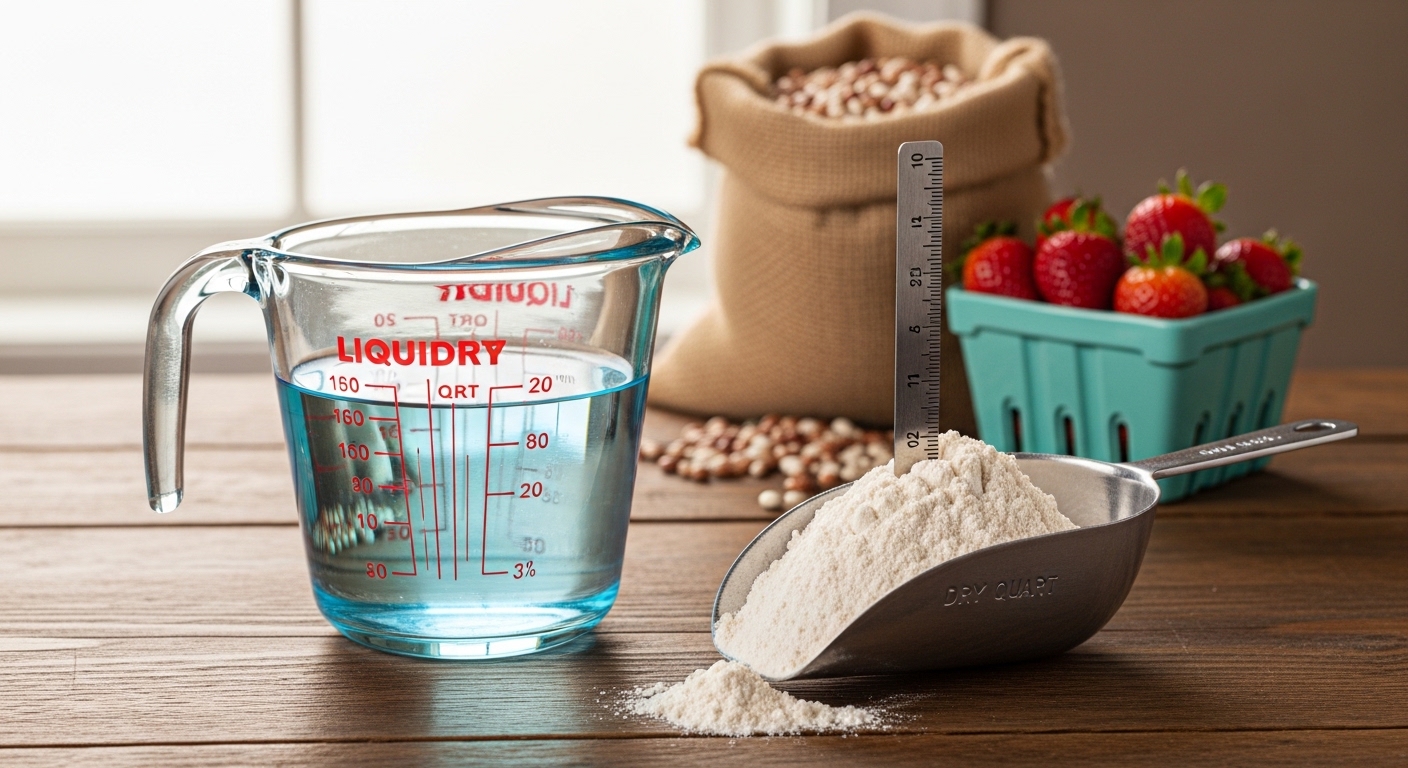
You have probably seen dry measuring cups labeled for flour or sugar. Did you know dry gallons and dry quarts exist too? The US has two different gallon systems: liquid and dry. They are not the same. This confuses many people because the names overlap.
The US liquid gallon equals 231 cubic inches. The US dry gallon equals 268.8 cubic inches. That means a dry gallon is about 16% larger than a liquid gallon. Consequently, a dry quart is also larger than a liquid quart. So the answer to how many quarts in a gallon changes slightly depending on which system you use.
Here is where trouble starts. When a recipe asks for a quart of strawberries, do they mean liquid measure or dry measure? Most modern recipes assume liquid quarts for everything unless specified otherwise. But old cookbooks and some farm stands use dry measures for produce.
How many quarts in a gallon the safe approach: when buying produce by the quart at a farmers market, ask if they use dry or liquid measure. Most commercial operations today use liquid quarts for simplicity. For cooking at home, treat 1 dry quart as roughly equal to 1.16 liquid quarts. Or better yet, use a kitchen scale. Weight eliminates the confusion entirely.
Imperial vs. US Gallons Why Your UK Recipe Might Be Wrong
How many quarts in a gallon he internet connects us to recipes from around the world. A British cake recipe might call for a gallon of milk. An Australian barbecue sauce might list quarts. But the UK and Canada use the Imperial gallon, not the US gallon. This difference will ruin your cooking if you ignore it.
One Imperial gallon equals 1.2 US gallons. More precisely, an Imperial gallon holds 160 fluid ounces, while a US gallon holds just 128 fluid ounces. That means an Imperial gallon is about 20% larger. Multiply that across quarts, and an Imperial quart is also larger than a US quart. Yet the number of quarts in a gallon stays 4 within each system.
How many quarts in a gallon f you see a British recipe asking for 1 gallon of custard, and you use US gallon measures, you will be short by about 20%. Your custard may not set correctly. Conversely, if a US recipe asks for a gallon of broth and you use Imperial measures, you will add too much liquid.
To convert: multiply US gallons by 0.83267 to get Imperial gallons. Or multiply Imperial gallons by 1.20095 to get US gallons. Most home cooks do not need extreme precision. But for baking or canning, pay attention. When in doubt, search for the recipe’s country of origin and adjust accordingly.
Real Life Scenarios Where You Will Use This Conversion
How many quarts in a gallon Let us move from theory to action. These everyday situations demand you know how many quarts in a gallon. Read through them, and you will see why this knowledge pays off repeatedly.
Cooking for a crowd: You are making gumbo for 20 people. Your recipe yields 2 gallons. You own quart-sized storage containers. How many quarts in a gallon containers do you need? Multiply 2 gallons × 4 quarts per gallon = 8 containers.
Mixing cleaning solutions: A floor cleaner concentrate says to mix 1 quart of product per gallon of water. You have a 5-gallon mop bucket. How much concentrate? 5 gallons × 1 quart per gallon = 5 quarts.
Watering plants with a rain barrel: Your rain barrel holds 55 gallons. You use a 2-quart watering can. How many quarts in a gallon trips to empty the barrel? First, convert 55 gallons to quarts: 55 × 4 = 220 quarts. Then divide by 2 quarts per can = 110 trips.
Brewing beer at home: A 5-gallon batch requires 12 quarts of sparge water. Will that fit in your 5-gallon mash tun? Convert 12 quarts to gallons: 12 ÷ 4 = 3 gallons. Yes, you have plenty of room.
Fuel for a generator: A storm is coming. Your generator uses 0.5 gallons per hour. You store fuel in quart bottles. How many quarts in a gallon bottles for 10 hours? 10 hours × 0.5 gallons = 5 gallons. Then 5 × 4 = 20 quart bottles.
Each scenario uses the exact same math. You multiply or divide by 4. No advanced calculations. No confusing formulas.
Common Mistakes People Make with Quarts and Gallons
How many quarts in a gallon Even people who know the right answer still slip up. Avoid these frequent errors to stay accurate every time.
Forgetting to convert before combining: You have 3 quarts of milk in one container and 1 gallon in another. How much total milk? If you add 3 quarts + 1 gallon without converting, you might incorrectly say 4 quarts. But 1 gallon = 4 quarts, so total = 7 quarts (or 1.75 gallons). Always convert to the same unit first.
Confusing quarts with liters: A liter is slightly larger than a quart. One quart equals about 0.946 liters. If a European recipe says 4 liters of stock, that is not the same as 4 quarts. Four liters equals about 4.23 quarts. The difference grows with volume.
Using the wrong measuring tool: A liquid quart measure has a spout. A dry quart measure allows leveling off. Using a liquid cup for flour compresses the flour. Stick to the correct type of measure for the ingredient.
Misreading abbreviations: “qt” means quart. “gal” means gallon. “q” alone is ambiguous. Double-check abbreviations to avoid misinterpreting 1 q as 1 quart or 1 gallon.
Assuming all gallons are the same: US liquid, US dry, and Imperial gallons differ. When a recipe does not specify, assume US liquid gallons if you live in the US. For international sources, verify.
Quick Reference Half Third and Quarter Gallons in Quarts
How many quarts in a gallon Sometimes you do not need a full gallon. You need a fraction. Here are the most common fractional gallon conversions.
Half gallon (0.5 gallons): Multiply 0.5 × 4 = 2 quarts. A typical half-gallon of ice cream holds exactly 2 quarts.
Quarter gallon (0.25 gallons): 0.25 × 4 = 1 quart. A quart is literally a quarter-gallon.
Third of a gallon (0.33 gallons): 0.33 × 4 = 1.32 quarts. That equals 1 quart plus about 1 cup.
Two-thirds of a gallon (0.66 gallons): 0.66 × 4 = 2.64 quarts. That equals 2 quarts plus about 2.5 cups.
Three-quarters of a gallon (0.75 gallons): 0.75 × 4 = 3 quarts. Many restaurant-sized condiment containers use this size.
One and a half gallons (1.5 gallons): 1.5 × 4 = 6 quarts. A typical beverage dispenser at a party holds this volume.
Two gallons (2 gallons): 2 × 4 = 8 quarts. Large stockpots for lobster or crab boil often hold exactly 8 quarts.
Memorizing these fractions saves time. You will not recalculate half-gallon to quarts every time. You will just know it equals 2 quarts. The same applies to quarter-gallon (1 quart) and three-quarter-gallon (3 quarts).
Teaching Kids the Gallon Quart Relationship with Simple Drawings
If you teach children how many quarts in a gallon, use a visual method. The “Gallon Man” drawing makes the system memorable for all ages.
Draw a large capital G on paper. This G stands for one gallon. Inside the G, draw four large Qs (one in each quadrant of the letter). Each Q stands for one quart. Inside each Q, draw two small Ps for pints. That gives you 8 Ps total. Inside each P, draw two small Cs for cups, giving you 16 Cs. The drawing maps the entire volume system inside one simple letter.
This technique works because it combines visual and kinesthetic learning. Children see the relationship as they draw. They physically count the Qs inside the G. Adults who struggled with conversions often find this drawing unlocks the concept instantly.
Another method uses containers. Fill a gallon jug with water. Then pour that water into four quart jars. Let the child perform the pouring. The hands-on experience etches the 1:4 ratio into memory far better than any flash card.
Conclusion
You now know the answer cold. One gallon holds 4 quarts. No exceptions. No tricky cases. Just a clean, unwavering relationship that simplifies recipes, home projects, and everyday math. Whether you scale a family meal to feed a crowd, calculate fuel for a road trip, or help a child with homework, the 4:1 ratio works every time. The next time someone asks how many quarts in a gallon, you will answer before they finish the question. And you will wonder why this ever seemed complicated. Keep measuring, keep cooking, and let that simple multiplication save you from second-guessing forever.
FAQs
1. How many quarts in a gallon of water?
Exactly 4 quarts. The substance does not change the volume conversion. One gallon of water, milk, or any liquid fills 4 quart containers completely. The weight varies by liquid, but the number of quarts stays constant.
2. Is 4 quarts the same as 1 gallon every time?
Yes, within the same measurement system. Four US liquid quarts always equal 1 US liquid gallon. Four Imperial quarts equal 1 Imperial gallon. The confusion only arises when mixing systems. Stick to one system for any single project, and the 4:1 ratio holds perfectly.
3. How many quarts in a half-gallon?
A half-gallon contains 2 quarts. This is one of the most useful conversions for everyday cooking because many products (ice cream, broth, milk) come in half-gallon sizes. Simply divide the gallon number by half, then multiply by 4 quarts, or memorize 2 quarts directly.
4.How many quarts in 2 gallons of paint?
Two gallons of paint contain 8 quarts. Paint stores often sell quarts for touch-ups and gallons for main coats. If a project needs 2 gallons, you could also buy eight quart cans, though gallon cans usually cost less per ounce.
5. Does the gallon-to-quart conversion work for dry ingredients like flour?
Yes, for US dry gallons and dry quarts. But remember: a dry gallon is larger than a liquid gallon. Most home recipes assume liquid measures even for dry ingredients unless labeled otherwise. For serious baking, use a kitchen scale to avoid confusion.
6. How do I convert gallons to quarts quickly without a calculator?
Multiply the number of gallons by 4 in your head by doubling twice. For example, 3 gallons: double 3 to 6, then double 6 to 12 quarts. For 5 gallons: double to 10, double to 20 quarts. This two-step doubling trick works perfectly.


