
.625 as a fraction is one of the most useful decimal conversions in basic and advanced mathematics because it reveals how cleanly decimals can transform into exact fractional values. .625 as a fraction equals 5/8, and this conversion is not just a memorized trick but a logical outcome of place value, division rules, and simplification principles. Understanding this conversion deeply helps you work more confidently with numbers in algebra, measurement, finance, and everyday problem-solving.
.625 as a fraction becomes especially important because it appears frequently in real-world calculations involving measurements, probability, and proportional reasoning. Once you understand how and why .625 converts into 5/8, you can apply the same logic to many other decimals without confusion or guesswork. This article breaks everything down in a clear, natural flow so you understand not only the answer but the reasoning behind it.
Understanding .625 as a decimal value before converting it
.625 as a fraction starts with understanding what the decimal actually represents in numeric form. The number .625 is read as six hundred twenty-five thousandths, which means it is 625 parts out of 1000 equal parts of a whole.
This interpretation comes directly from place value rules in the decimal system. Each digit after the decimal point represents a decreasing power of ten:
- The first digit is tenths
- The second digit is hundredths
- The third digit is thousandths
Since .625 has three digits after the decimal point, it sits in the thousandths place. That is why it can immediately be written as:
625/1000
This step is the foundation for converting .625 as a fraction correctly. Without understanding place value, it becomes easy to make mistakes or choose the wrong denominator.
Turning .625 into a fraction step by step
To convert .625 as a fraction, we first express it in its decimal fraction form:
.625 = 625/1000
Now the goal is to simplify this fraction into its lowest terms. Simplification means dividing both numerator and denominator by their greatest common divisor so the fraction becomes as simple as possible while keeping the same value.
The greatest common divisor of 625 and 1000 is 125.
Now we divide both numbers:
625 ÷ 125 = 5
1000 ÷ 125 = 8
So the simplified form becomes:
58\frac{5}{8}
This is the final answer for .625 as a fraction.
The simplicity of the result is what makes this conversion so elegant. A decimal that looks slightly complex reduces to a small and familiar fraction.
Why .625 as a fraction becomes 5/8 so cleanly
The reason .625 as a fraction simplifies so neatly lies in how the decimal system interacts with powers of 10. The number 1000 is made up of prime factors:
1000 = 2 × 2 × 2 × 5 × 5 × 5
The number 625 also has a structured factor composition:
625 = 5 × 5 × 5 × 5
Because both numbers share common factors of 5, they simplify easily when divided. This creates a natural reduction pathway that leads directly to 5/8.
This is why .625 is not a repeating decimal or a messy fraction. Instead, it belongs to a group of terminating decimals that simplify perfectly into rational numbers.
The relationship between .625 and common fraction benchmarks
To fully understand .625 as a fraction, it helps to compare it with other familiar decimals and their fractional equivalents. Many of these values are based on halves, quarters, and eighths, which are foundational in mathematics.
- .25 = 1/4
- .5 = 1/2
- .75 = 3/4
- .125 = 1/8
- .625 = 5/8
These values are not random. They come from dividing a whole into powers of two. That is why .625 fits perfectly into the eighths system.
When you divide 1 into 8 equal parts, each part equals 0.125. If you take five of those parts, you get 0.625, which explains the direct connection between .625 and 5/8.
Visualizing .625 as a fraction in real-world terms
Understanding .625 as a fraction becomes much easier when you connect it to physical or practical examples. One of the most common uses of 5/8 appears in measurement systems, especially in construction and engineering.
For example, if a wooden plank is labeled as 5/8 inch thick, that means it is 0.625 inches thick. Instead of measuring in decimals, professionals often prefer fractions because they divide materials into standard sizes more efficiently.
Another example appears in cooking. If a recipe requires 5/8 of a cup, it can also be written as .625 cups. However, most cooks prefer fractions because measuring cups are typically marked in fractional units rather than decimal units.
This real-world relevance shows that .625 as a fraction is not just a mathematical concept but a practical tool used in daily life.
Why fractions like 5/8 are preferred over decimals in many cases
Even though .625 is perfectly accurate in decimal form, 5/8 is often preferred in many fields because it is easier to interpret visually and mentally.
Fractions like 5/8 provide immediate structural understanding. You can see the relationship between parts and wholes more clearly than with decimals.
For example, comparing .625 and .6 is not immediately intuitive for everyone. But comparing 5/8 and 3/5 makes it easier to understand which is larger when visualized as parts of a whole.
Fractions also avoid rounding errors that sometimes occur in decimal-based calculations, especially in long mathematical expressions.
Common mistakes when working with .625 as a fraction
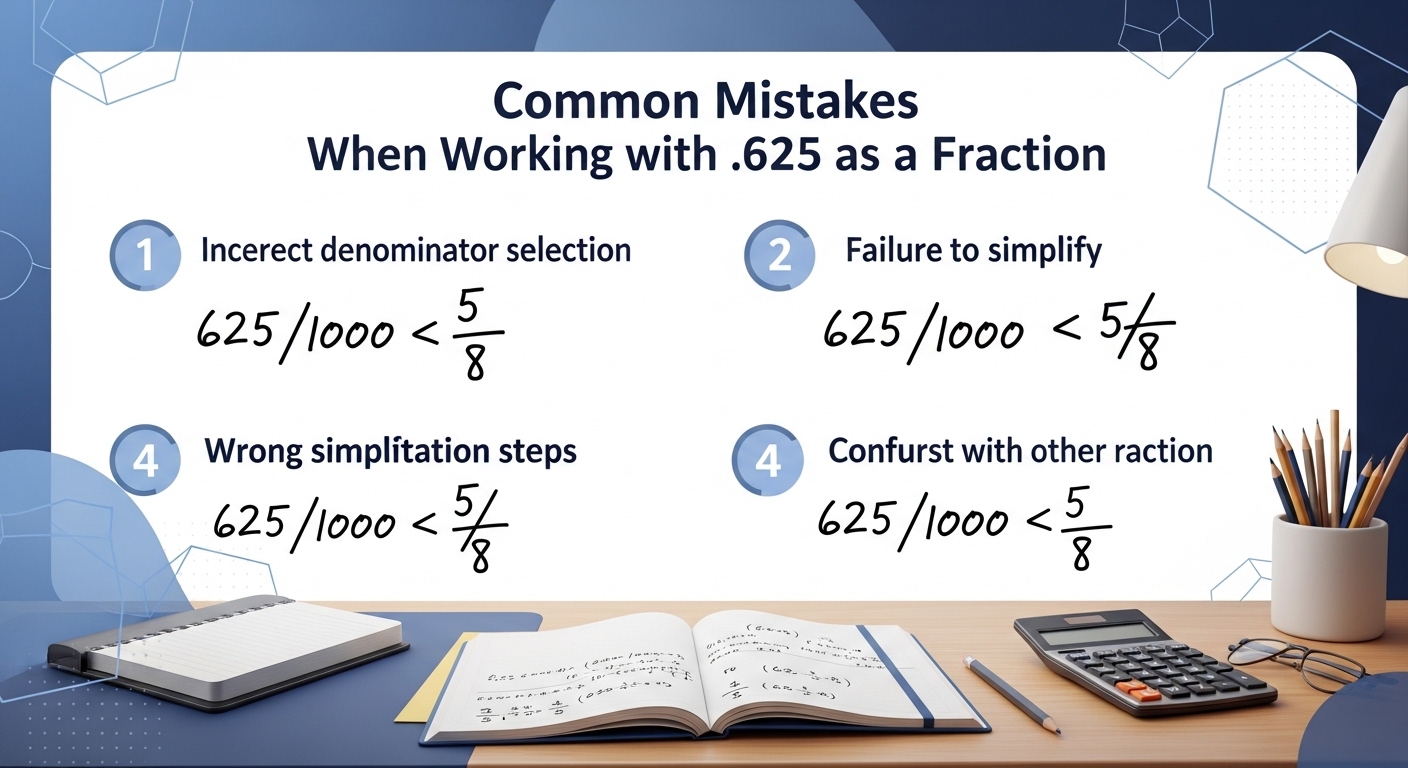
Even though .625 as a fraction is straightforward, several common mistakes still occur during conversion.
One frequent mistake is writing 625/100 instead of 625/1000. This ignores the correct place value of the decimal. Since .625 has three digits after the decimal, it must be written over 1000, not 100.
Another mistake is failing to simplify the fraction. While 625/1000 is correct, it is not in simplest form. Leaving it unsimplified reduces clarity and does not meet standard mathematical convention.
A third mistake is incorrectly simplifying the fraction using the wrong divisor, which can lead to incorrect results like 1/2 or 3/4.
Avoiding these errors ensures that .625 as a fraction is always expressed accurately as 5/8.
Converting .625 as a fraction using an alternative method
Although the standard method involves using 1000 as the denominator, there is another way to understand the conversion using division.
You can interpret .625 as 625 ÷ 1000 directly. Then simplify step by step:
- Divide both numbers by 5
- Continue simplifying until no common factors remain
This process still leads to:
5/8
Another perspective is recognizing that .625 is equivalent to 62.5%. Since 62.5% equals 5/8 when converted into fraction form, this provides another confirmation of the result.
How .625 as a fraction connects to percentages
.625 as a fraction also connects directly to percentages. When converting decimals to percentages, you multiply by 100:
.625 × 100 = 62.5%
Now converting 62.5% into a fraction:
62.5/100 = 625/1000 = 5/8
This reinforces the consistency between decimals, fractions, and percentages. They are simply different representations of the same value.
Understanding this relationship helps you switch between formats quickly depending on the context of a problem.
The role of .625 in algebra and advanced math
In algebra, .625 as a fraction becomes especially useful because exact values are often required instead of decimals. Fractions like 5/8 maintain precision in equations and prevent rounding errors that could affect final results.
For example, in algebraic expressions involving ratios or proportional reasoning, using 5/8 instead of .625 ensures cleaner simplification and more accurate outcomes.
It also appears in probability calculations where exact fractions are preferred over decimal approximations.
Why .625 is part of a larger mathematical pattern
.625 as a fraction belongs to a broader pattern of decimals that are powers or combinations of halves and eighths. These numbers are structurally connected because they originate from dividing a whole repeatedly by 2.
Here is how the pattern builds:
- 1/2 = 0.5
- 1/4 = 0.25
- 1/8 = 0.125
- 5/8 = 0.625
This pattern shows how binary division naturally leads to decimals like .625. It is part of a predictable system rather than a random decimal value.
Why understanding .625 as a fraction improves number sense
When you understand .625 as a fraction, you are not just learning a single conversion. You are building number sense, which is the ability to understand relationships between numbers intuitively.
This helps in estimating values, checking answers quickly, and understanding proportions without needing a calculator.
For example, knowing that .625 equals 5/8 allows you to quickly estimate that it is slightly more than half but less than three-quarters.
This type of understanding is extremely useful in problem-solving and real-world decision-making.
.625 as a fraction in comparison with other decimals
Comparing .625 with nearby decimals helps reinforce its value:
- .6 = 3/5 = 0.600
- .625 = 5/8 = 0.625
- .7 = 7/10 = 0.700
This shows that .625 sits neatly between .6 and .7, but its fractional structure is more refined due to its connection with eighths.
This comparison helps clarify why .625 is often used in precise calculations rather than rounded approximations.
Conclusion
.625 as a fraction ultimately simplifies to 5/8, revealing a clean and structured relationship between decimal and fractional number systems. What begins as a seemingly ordinary decimal transforms into a precise and meaningful fraction that appears frequently in mathematics and real world applications.
Understanding this conversion strengthens your ability to move between number forms effortlessly, recognize patterns in decimals, and apply mathematical reasoning with confidence in both academic and practical contexts.
Frequently Asked Questions
1. What is .625 as a fraction in simplest form?
.625 as a fraction in simplest form is 5/8. This is obtained by writing 625 over 1000 and simplifying both numbers using their greatest common divisor, which is 125.
2. Why does .625 equal 5/8?
.625 equals 5/8 because both numbers simplify to the same value when reduced. The decimal represents 625 thousandths, which reduces cleanly to 5 parts out of 8 equal parts.
3. Is .625 a terminating decimal?
Yes, .625 is a terminating decimal because it ends after three digits. All terminating decimals can be expressed as exact fractions.
4. How do you convert .625 into a fraction quickly?
Write .625 as 625/1000, then divide both numerator and denominator by 125 to get 5/8. This is the fastest and most reliable method.
5. Where is .625 used in real life?
.625 or 5/8 is commonly used in construction, cooking measurements, engineering specifications, and any field that relies on precise fractional units.
6. Is .625 more than half?
Yes, .625 is greater than 0.5 (1/2) but less than 0.75 (3/4). In fraction form, 5/8 is slightly more than half of a whole.


